Barely staffed Southeastern station sees 6,500 homes rise in Kidbrooke
With a few hours to spare last week I thought it’d be worth popping over the Kidbrooke given I was in the area to see how the various housing developments are shaping up.
And well, there’s plenty to see from Greenwich Council’s blocks being built under the excellent Greenwich Builds programme to a couple of plots from Berkeley Homes on the old Ferrier estate.

In addition, more people have moved into Transport for London’s development directly next to the station where work halted two-thirds through.
In total around 6,500 new homes are either built or on the way.

Whilst development on Berkeley sites continues a short distance to the south of the station.
It’s one of a number of plots I’ll look at a little later.

Transport
Despite being a hive of construction activity it was evident that Southeastern’s Kidbrooke station – at the centre of it all – again encapsulates how the Metro rail operation and its passengers are badly served.
Upon arrival the ticket office was closed but the station building was at least open.

Constructed not too long ago, the station building was altered post-planning submission to remove a ticket barrier line. That would require Southeastern to have decent levels of staffing, and so clearly that wasn’t on the cards.
By the time I’d popped to the shops and had a wander – and it was now approaching the evening peak – the station building had been completely closed.

Entrance was via a side gate.
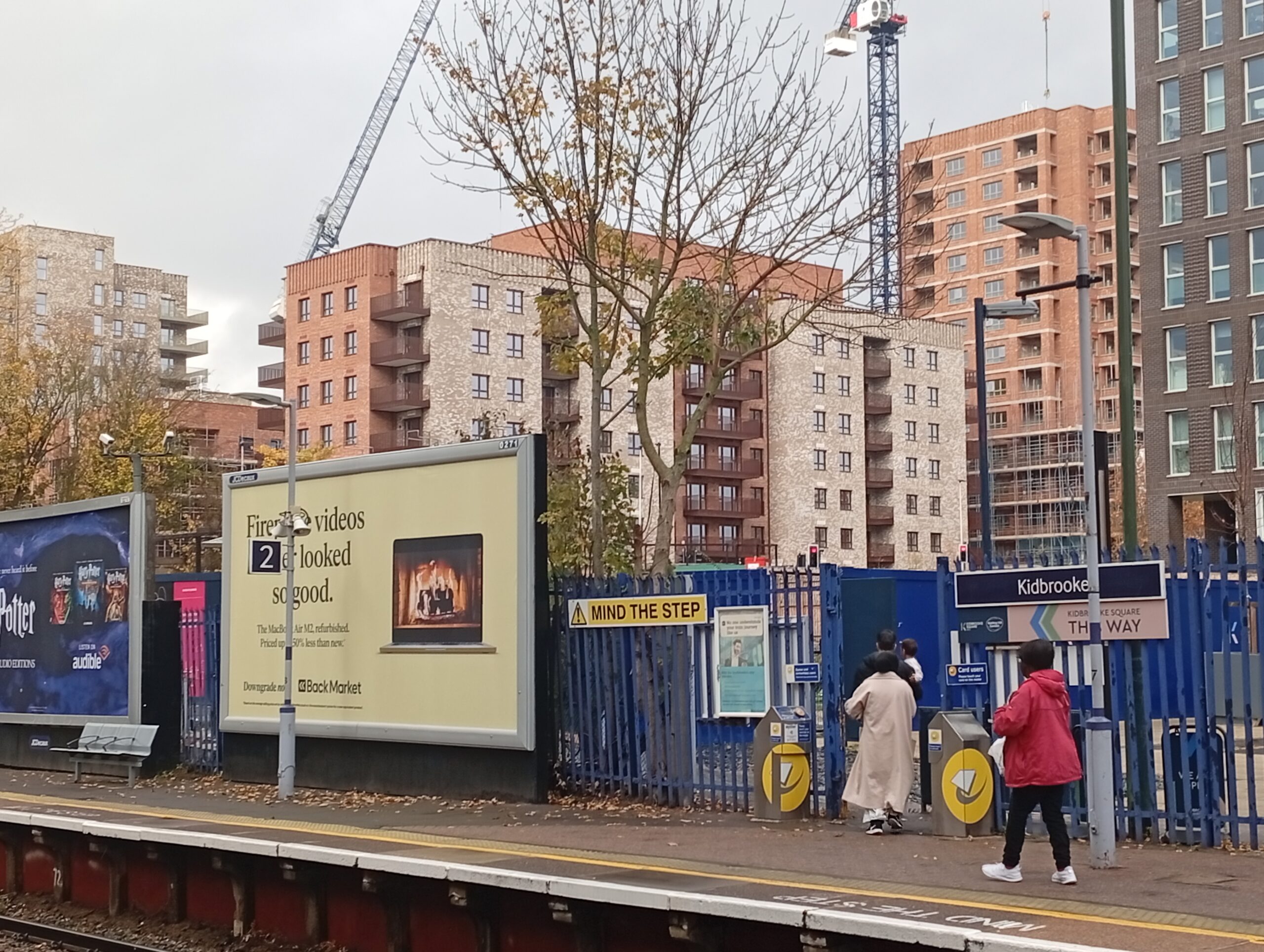
Money well spent. Note new builds to the rear.

On the other side of the station beside the Kent-bound platform is a plot where 619 homes from TfL will eventually be situated alongside 442 from Greenwich Council nearby yet there’s nothing for access except a small gate. Around 400 homes from TfL have now finished.
An actual station building, decent shelter within or staffing? No chance.

Note the old Connex yellow colours showing through. Sort of sums it up. Little change in staffing or access for 20 years despite massive changes.
Again, here’s 6,500 homes being built alongside thousands of existing homes around Kidbrooke station. This isn’t a backwater. It’s a densely populated area that’s changed a lot in twenty years. In many areas such a spot would see a well staffed station offering guidance, revenue protection and safety to passengers.
Elsewhere
Note how new stations on TfL see decent levels of staffing (Barking Riverside for example) or on Greater Anglia (the recently opened Beaulieu Park). Sure, Kidbrooke station isn’t new but thousands of homes are, and there’s was a blank slate for new station buildings.
Maybe I’m extremely unlucky but no staffing and a closed station building seems to happen most times I visit. It’s far worse than most other Train Operating Companies manage or Transport for London. None are perfect but few as scantly staffed as Southeastern Metro.

I know some say stations like Kidbrooke are overwhelmingly used for heading to central London but that’s pretty dated thinking given it’s a Metro system. Of at least in terms of what the metro system could be.
It offers plenty of journey opportunities to various town centres across south east London to shop, drink, exercise and whatever else. Considering it a purely commuter network is wildly outdated.

The next station along to the west is Blackheath with plenty of shops, bars and the heath for recreation. To the east are stations with numerous shops nearby such as Eltham.
Kidbrooke itself could even be thought of as more of destination now with a gym, shops, supermarkets and pub all close to the station.

Many stations are destinations in their own right and not merely places for commuters to trudge through in the morning to get to work, then head homes of an evening. Of course that is a hefty element of the network’s patronage, but far from all. Or at least it shouldn’t be if considered as a true Metro network.
Engagement with planning process
When it comes to the metro network there’s always the issue of just how much (or little) Network Rail and Southeastern engage during the planning process for new housing. Having read many hundreds of reports for major new housing schemes over the years across south east London there’s very rarely any feedback or suggestions from either rail organisation to councils.
See the report before Lewisham councillors next week for 620 homes at Leegate.

Lee station is near the site though the report notes no engagement from Southeastern or Network Rail. TfL in contrast offer extension engagement in every single application including the one for Leegate in terms of buses, rail modes such as the DLR or tube (if applicable), pedestrians and cyclists but as they don’t run the trains they can’t offer much there.
Like many other stations on the Southeastern Metro network, Lee station has limited staffed with no ticket gates.
See also Plumstead with 2,600 homes on the way nearby, Woolwich Dockyard with 766, Crayford with 568, Deptford with 1,000+ on the cards at various sites around the creek and near the High Street, and on it goes.
Housing
Back to Kidbrooke housing sites and the biggest area of development in Kidbrooke is Berkeley Homes’ phases on the old Ferrier Estate.
Currently the final blocks of phase 3 are well underway. One block is looking almost complete.

Work is also ongoing at Phase 2 with Phase 5 blocks along Kidbrooke Park Road looking like they may get moving soon. An earlier block in Phase 5 recently completed.
That was covered recently. The only phase yet to commence is Phase 6.

Moving north and residents are now moving into TfL’s blocks built alongside Notting Hill Genesis. Two towers have yet to complete. One started before the plug was pulled.
There was silence for years and no mention from either Greenwich or TfL in reports on borough housebuilding until recently when as suspected it was second staircase rule that is currently the issue.

A short distance away are Greenwich Council’s blocks. They may well be the most attractive of the lot.
A large scale scheme built by the authority it’s likely to be the last such scheme as this government want’s councils to work in “partnership” rather than build outright or take a strong lead.

So it’ll be back to selling land or entering an agreement with public land and hoping the partner gets a move on rather than sits on it for years. Not exactly a roaring success of a model for decades with many examples locally let alone more widely.
Greenwich peninsula, Royal Docks, Silvertown Quays to name but three.
Improvement
In the recent past Southeastern and Network Rail have joint forces as a single organisation. Network Rail has been in public hands since Railtrack went under while Southeastern has been since 2021.
Despite his process there’s no sign that unified group is engaging with authorities when it comes to new housing and development to any real degree. Certainly not in the many council reports being drawn up that list responses from various organisations.

If Southeastern won’t do much to improve staffing and station access with 6,500 homes in the near vicinity of a station, when will they?
On a wider level improved staffing, stations and services ultimately comes down to the Department for Transport to support and fund. This government shows little sign of doing that.
Remember they campaigned against service reductions in opposition when the Tory-run DfT pushed them through – and yet retain many now they’re in power. Kidbrooke station also now sees half the Charing Cross services across much of the day it formerly enjoyed at just one per hour.
Maybe Great British Railways when it commences will be different as its been a long time since anyone seemed to care for the Metro network. Network Southeast was probably it before privatisation.
In the near term the chance of many improvements on Southeastern Metro look limited at best and it’s harming what could be a fantastic Metro network serving many growth areas. It’s frustrating to see opportunities missed time and again to offer a better alternative to the car.


