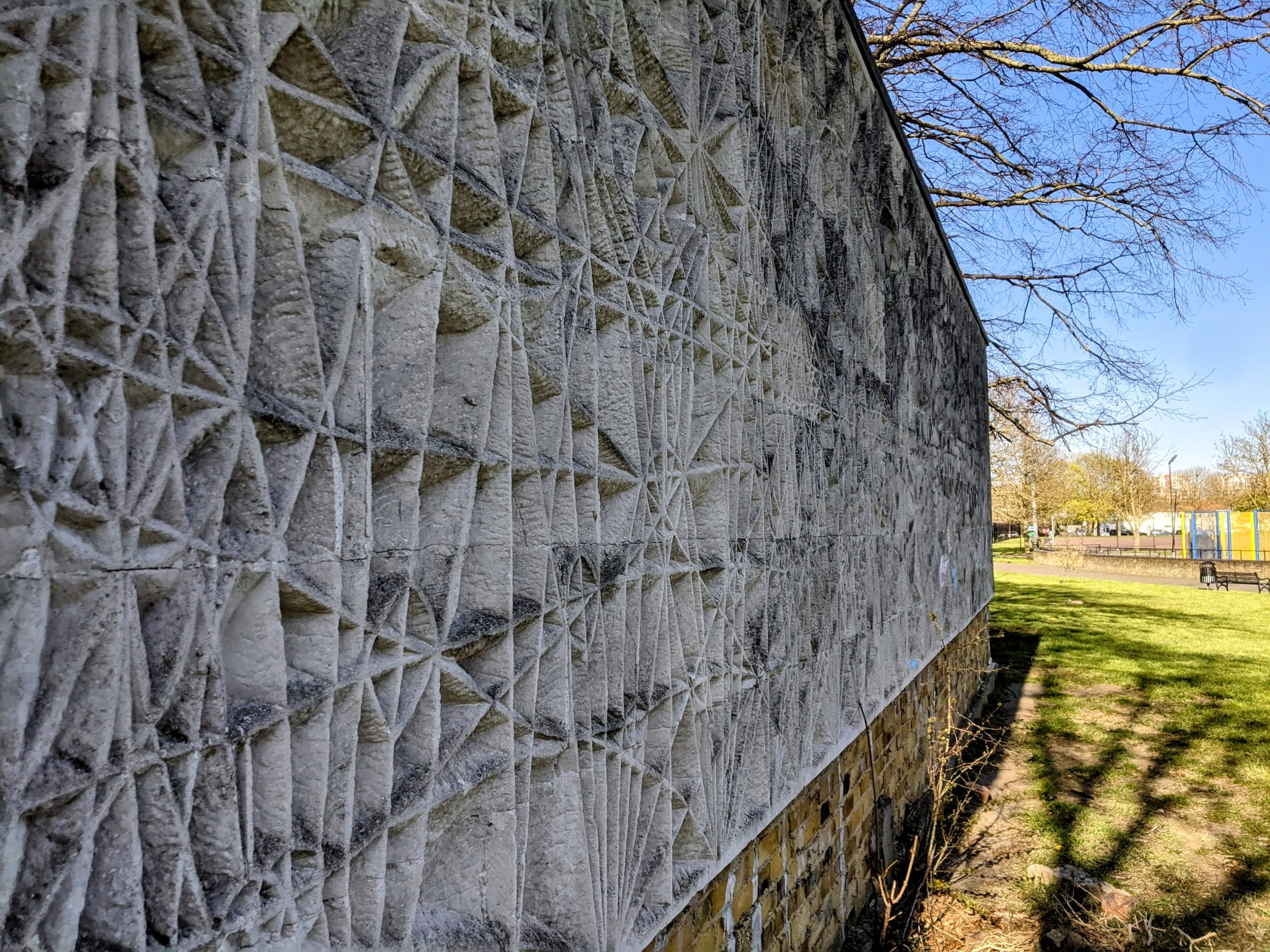
The forgotten Grade II-listed artwork on a south east London estate
In a corner of south east London sits a listed piece of art work known by few and almost forgotten.
This is “The Delight” in Abbey Wood park within a London County Council-developed estate dating from the late 1960s.

Growing up locally I was never even aware their was a listed sculpture/mural/art piece on the estate and a recent visit shows no signage whatsoever either on it or nearby.
There’s little online too with Greenwich Council stating:
“There is a large, Grade II-listed sculpture of dancing ballerinas in the park, named The Delight. It is by the artist Alfred Horace Gerrard. Designed from 1962 onwards, possibly as a commission by the London County Council for inclusion in the building of Thamesmead, it was unveiled in 1967.”
But very little else.
I’m not sure about it being designed for inclusion in Thamesmead. If commissioned in the the early 1960s that predates Thamesmead by some time with the first homes completed in the late 1960s but matches with the estate completion in Abbey Wood.

Sculptor and teacher
Alfred Horace Gerrard was a modernist sculptor who taught at the Slade School of Fine Art at University College London. In the 1930s he was commissioned by Charles Holden and Frank Pick to work on the headquarters of the London underground at 55 Broadway.
Another transport link with Gerrard is that one of his students was Eduardo Paolozzi, whose behind a listed and rather well know mosaic at Tottenham Court Road station.

Abbey Wood estate
Abbey Wood estate begun in the mid 1950s and was mostly complete by 1960. The timeline matches.

Mostly consisting of traditional brick buildings the last stages saw a major shift in architectural style.
Still, it’s generally a world away in architecture from the radical Thamesmead concepts adopted next door featuring extensive pre-cast concrete panels at housing with extensive walkways and the town shops located above a car park.

What’s also interesting to note is how many services and amenities in both Abbey Wood and Thamesmead arrived last. It’s common to hear people complain about new builds saying the amenities aren’t there “as they used to be on developments”.
Not true. Abbey Wood is one of many examples. In fact an old hut in use as a shop and post office still stands beside Eynsham Drive and William Temple church decades after closure.

Impressive achievements
Still, the entire estate including three primary schools, one secondary school, two shopping parades, doctors, dentist, substantial park and landscaped garden, library and pubs was built far quicker than equivalent builds today which are dragged out often extremely slowly.
Think of nearby Thamesmead. In more than eleven years in charge Peabody have managed to build just one out of seven planned plots despite flattening half of south Thamesmead near the Elizabeth line station.
Oh, and in Abbey Wood the LCC also managed to build a flyover across the railway and two pedestrian footbridges over tracks. Amazing what could be achieved in a time of post-war austerity that now government’s of all types seem unable to achieve.

The country may have been broke after World War Two but the UK built many more homes annually than levels seen over the past 50 years when richer.
Public art was also a key tenet for the London County Council. One well known example, for instance, is a Henry Moore installed on Stifford estate in 1961.
With so much emphasis on wide-ranging public services under the forceful direction of the London County Council it’s of little surprise public art should also be commissioned and installed – but which is now unknown by many.
Fifteen minute town
It was a time of greater civic pride when the working classes deserved good quality, affordable homes and sufficient services nearby. A 15-minute town/city you may say with doctors, dentists, shops, pubs and much else – before the conspiracy theorists went nuts about such things.
Abbey Wood estate’s design even pre-saw the rise of the car with what we now call LTNs baked into the design.
Though rather than a gate across a road it simply had green space and cul-de-sacs ensuring all traffic used a few designated roads either through the site (Eynsham Drive) or on the edges (Sewell Road and Mottisfont Road to give two example) with link roads between.
But anyway, for now the listed sculpture survives. Known by few and seemingly forgotten it’s a glimpse into a different time.
I’d love to know if anyone has any memories of it from decades past. If you do remember anything please do leave a comment below.


I was raised in Stanbrook rd flats then moved to a maisonette in Sewell Rd. I went to Richard de Lucy primary school then Abbey Wood comprehensive school. Twice a year we had flood drill at the primary school where we walked to Alexander McLeod primary school on upper Abbey Wood because of flood risk. My family used to walk regularly along the sewer bank that ran along Sewell Rd to Southmere park, Lessness Abbeywoods and come back via Abbey Wood village. In the summer, if mum had the money we would get an ice cream. We had an annual bonfire night display arranged by the neighbours and everyone in my area kept their area clean.
I remember the wall but no one took any notice of it.
Here’s some more interesting info about the wall and its sculptor from some auction sites that talk about related pieces up for sale a few years ago.
https://www.the-saleroom.com/en-gb/auction-catalogues/dreweatts1759/catalogue-id-drewea1-10111/lot-4db61ed8-117c-4631-a922-aa7300f60f8e
Apparently it’s thought that the sculpture in Abbey Wood Park was likely part of a 3-part commission, which also included one called “Joy” and another called “Dance”, and it’s believed they were made from stone from the old Euston station when it was demolished. Gerrard was awarded a silver medal from the Royal Society of British Sculptors for the piece at Abbey Wood.
There’s a bit more info at the very bottom of this fascinating article too: https://www.artsandcollections.com/sculptures-from-the-park/