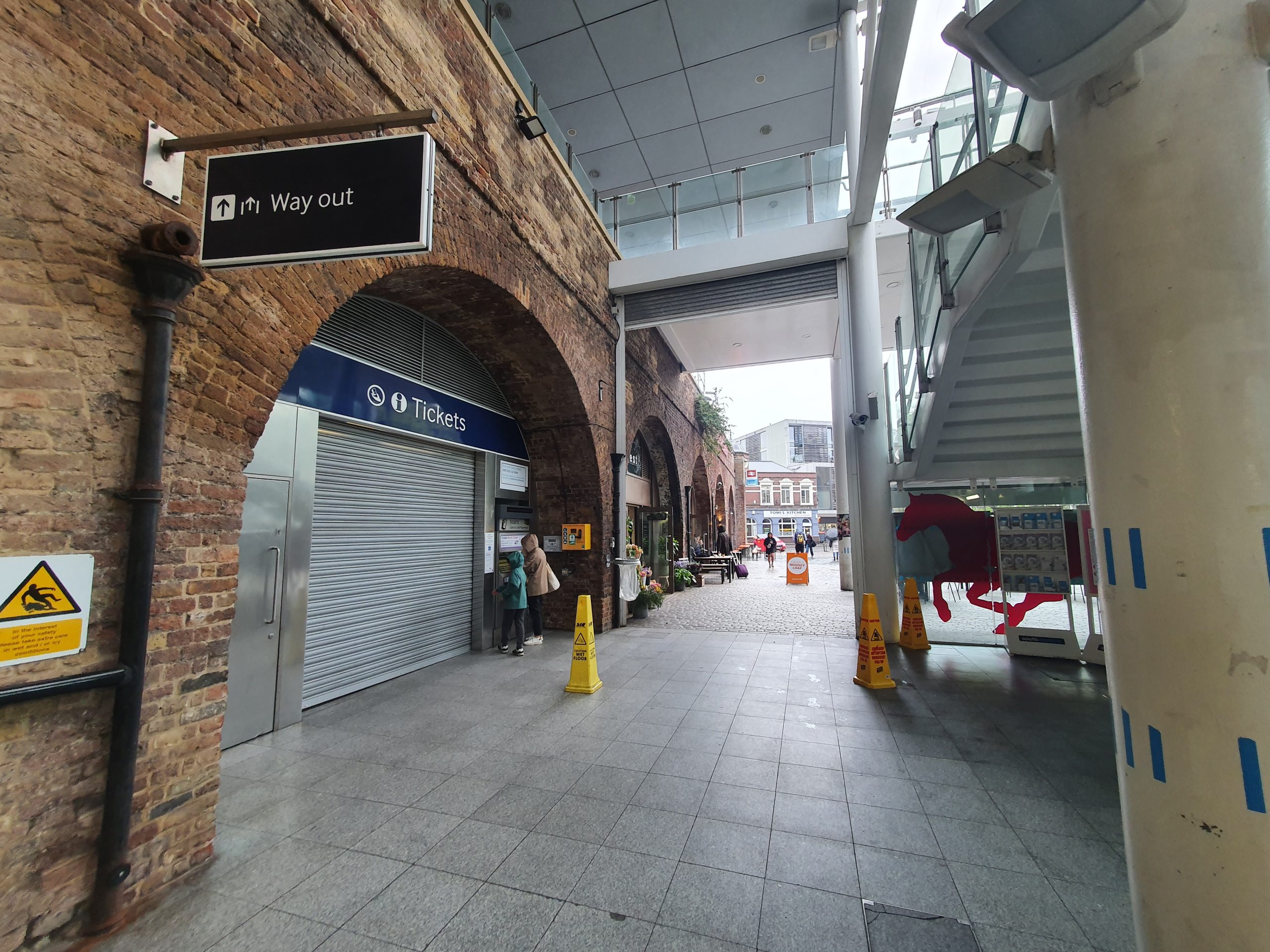
Chronic lack of station staffing remains at fast growing Southeastern Metro stations
In parts of the UK 6,000 new homes proposed in a town can sometimes be enough to gain an entirely new railway station to accommodate forthcoming passengers, with spending in the tens of millions.
And if not that level of investment, new housing in the thousands usually presents a comprehensive upgrade of existing station buildings and increased staffing levels for many potential users. That is, except, on Southeastern Metro where many areas of substantial housing and population growth remain locked in the distant past.

So what specifically triggered this article today? Well, noting continual staff shortages at Kidbrooke where around 6,500 new homes have or are being built whilst visiting newly built stations that were far better staffed on London Overground and Greater Anglia to give two examples.
In Kidbrooke a lack of staffing has again been evident this week with the ticket office and main station building shut.

And it’s nothing new. Recently I wrote a post looking at all the new housing rising in the town and as is common, whilst there the new station building was closed.
All the town has seen for vast housing growth in the past few years is that small new building on the London-bound platform located amongst a sea of residential tower blocks – and even that is often shuttered.

It was revealing that when plans for the new building were submitted it included ticket gates. They were removed in a revised application as it’d require staffing to be there. As it is, access if often via a side gate due to no staff whatsoever to even keep the building open.
That’s for the southern side of the station next to Kidbrooke Village which will total 5,300 homes when complete.

All sides
On the other side of the station beside the Kent-bound platform there’s three major developments: One from TfL which will comprise 619 homes and two from Greenwich Council which totals 500. Not too far away is another 100+ homes.
Yet no new building on that side of the station is planned nor ticket gates. Access remains a small gap in the fence.

As such like many other stations payment appears optional. No gates and no onboard staff.
Would gates stop all ticket avoidance? Of course not as we often see with some barging through where they exist. However there’s persistent offenders and opportune people who’ll chance it if no gates or left open. Those are the ones Southeastern make next to no effort to stop.
Compare this to station’s like Barking Riverside. It’s gated and well staffed even though the eventual 20,000 homes planned are many years away.

See also Cambridge North which opened not too long ago. It’s gated and well staffed under the control of Greater Anglia. Again, many new homes, offices and other development nearby are planned by much is years off.
A new Cambridge South station is set to open soon. I’d wager when it does so it’ll be well staffed from the get-go. Greater Anglia seem far better at doing so in busy towns and urban areas.

Kidbrooke, which has already seen thousands of new homes with plenty more now underway and 1.4 million passenger journeys annually, barely gets a solitary staff member.
Other growth areas
This is hardly unique for Southeastern Metro stations. Deptford is another site of substantial housing growth and staffed little differently to how it was in the 1990s.

I recall travelling through in the 1990s and you’d be lucky to see more than two people board. Now it’s far busier but staffing is still very low. It was another station rebuilt due to new housing, shops and bars in the vicinity but then never saw the day to day investment.
In the past year hundreds more homes have completed a short walk away.
Sometimes you have to wonder if Southeastern even want revenue from passengers. It can feel like the little missed Silverlink in places.

The company did recently run a recruitment drive for staff but it merely seems to have returned levels from mass short staffing to the barely-there level seen at many Metro stations in prior years rather a net increase to enhance to accommodate growing housing developments near stations and potential passenger growth.
New homes and college but same lack of staffing
Another good example aside from Deptford is Plumstead station where the first residents are set to move into a development that will total 1,913 dwellings.
Another nearby site includes a new college and 300 homes which is looking all but complete.

Will we see anymore staffing at Plumstead station than the minimal levels currently seen? Don’t bank on it.
Some argue most passengers are going to central London where there’s ticket gates but that is a fundamental misunderstanding of Southeastern Metro.
Because, well, it’s a Metro network. It serves many busy towns within London and built-up parts of north Kent where many people make point to point journeys that aren’t all heading into central London.
As many towns on the network grow, more people will travel to and from local stations given increasing local amenities and homes.

When the new (well, replacement) college opens near Plumstead station in the near future people may travel from, say, Woolwich Dockyard to Plumstead to study.
Newcomers to housing near Plumstead station may work or study at Greenwich university. Perhaps visit shops near Charlton station as it beats the bus for speed, and many homes are car-free.
Or watch a football matching the town. Maybe take a train to Maze Hill beside Greenwich park with the kids. Many stations along the route have their own employment, education and leisure offerings. Most are little staffed with no ticket gates.
This part of London has and continues to change while the rail network is managed like it’s 40 years ago.

Woolwich Dockyard is another spot where major development is ongoing. The old Morris Walk estate is seeing new homes with a substantial net increase on what stood before. A site nearby in Charlton is completing.
It’s another that has changed little for 30+ years.
In fact, many stations across the network could be highlighted. Lower Sydenham, Crayford, Stone Crossing, Greenwich and plenty more.
Crayford has 558 homes planned very close to the station. It’s near shops and the town centre. It’s staffed like a rural station.
The Elizabeth line, DLR or tube are not the only game in town for many people in these areas. They don’t serve many new homes or many possible popular destinations.
Safety
Aside from the lack of revenue that unstaffed and open stations presents on a network that also has no onboard staff, it hardly acts to encourage usage and increase feelings of safety.
Some won’t worry about that but a fair few will be reluctant to use a network where seeing a staff member doesn’t happen on a train or at a station.
It’s hardly the safest at times. I’ve seen people bottled at Deptford station and been attacked at Eltham in the evening – when all staff finished by 8pm despite how busy that station is.
Again, staffing isn’t some magic panacea that will prevent incidents like that but as with fare evasion and ticket gates it can help to reduce it. On Southeastern Metro there’s not even an attempt in many places.

Ultimately it remains a network with fantastic potential to grow and entice passengers with investment yet we see little attempt to reap potential rewards as thousands of homes rise around numerous stations let alone encourage more existing residents to use it.
Low levels of station staffing, poor quality or shut station buildings, no onboard staff and even the bulk of the fleet being 30+ year old Networkers that never saw a proper refurb all squander what’s there.
Will there ever be funds to improve the passenger experience at stations? Will Charlton and Woolwich Dockyard, to give two of many examples, still see as few staff after thousands more homes rise there?

A lot will depends on Great British Railways which isn’t due to begin until 2027 and how government fund and structure the organisation. In the here and now Southeastern and Network Rail have merged operations which is supposed to reduce costs.
Whether any of that saving helps bolster station staffing and improve the Metro network – or simply heads to the Treasury – remains to be seen.


More staff are need to be employed at all railway stations from first to last trains 7 days a week to provide help and assistance to passengers and Imprive safety for passengers while also cutting down on fare evasion.
They are enough people looking for work in a customer services and enjoy working with and interacting with the public.
If the Government want to get more people back into work then they should be working with large employers to create jobs for people.
Too many jobs have been lost to automation in the work place. This needs to change and we need to see more people providing face to face services for customers.
Southeastern is a publicly owned operator, owned by the DfT.
Yet Greater Anglia and London Overground are both operated by private companies.
It goes a bit beyond that. London Overground is a concession but the public body – TfL – specify service levels, staffing levels, fares, and much else.
Greater Anglia’s fares, service levels and poissibly staffing are set by government. How they manage to do so much better I suspect is due to their inner London services being devolved to TfL so they can focus on mid and long distance routes where they do very well.
Southeastern don’t seem to care about their Metro operations – which were never devolved – to any great extent and instead focus on HS1 and the mainlines. Their government masters much like their private predecessors seem to regard suburban and metro services as an inconvenience and so it’s often ignored and we see the result: few staff, cut services and an all-round feeling of being the awkward, unwanted element of the network. The crying shame is it shouldn’t be that at all given the possible growth options that clearly exist.