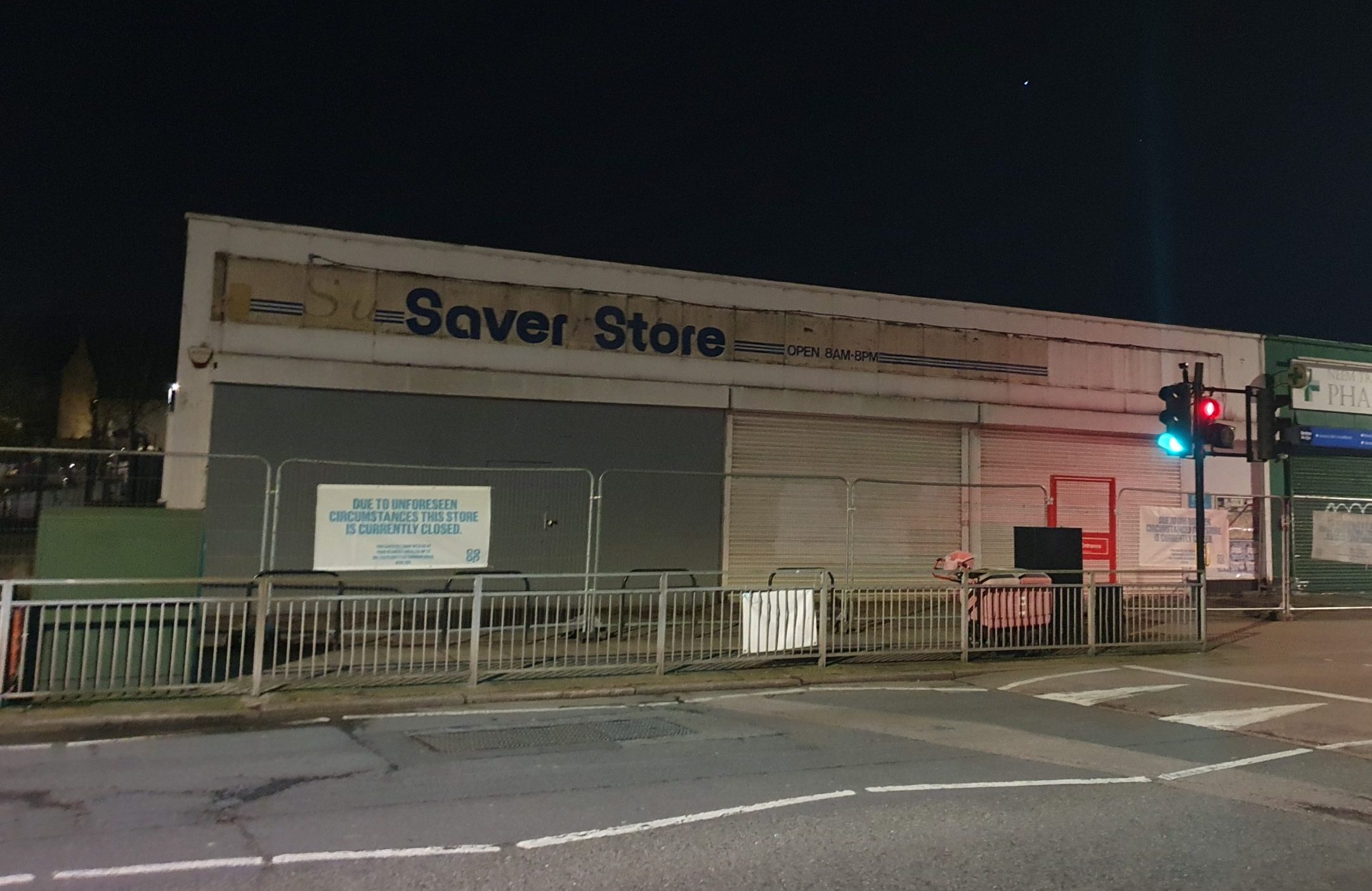
Long hidden Royal Arsenal Co-operative Society signs revealed by Abbey Wood fire
A fire at an Abbey Wood branch of the co-op has seen decades-old signage revealed.
And it appears that not only has “Saver Store” branding reappeared but possibly something a fair bit older still, with one panel exhibiting signage from some years before.

However this isn’t the original which was a far more ornate affair.
Here’s what we’ve lost.

Note the passing tram. Abbey Wood tram depot was situated nearby and converted to buses in 1952. It saw bomb damage in the second world war.
The entire site closed and moved to the newly built Plumstead bus garage in 1981.

Now I’m not one for nostalgia and have little time for blind “it was all much better in the old days” statement (as most of the time that’s pure rose-tinted glasses) but Abbey Wood co-op really does highlight a stark decline.
This is how the shop looked like recently before the fire.

All that gorgeous detailing lost over time until it became an utterly bland and forgettable number of shop frontages. No care, pride or love on show from the co-op.
The same can be said for the street itself. Ornate street furniture replaced with what is now the most cheap, bland types available.
Not just any shop
What’s really significant about the Abbey Wood store is that not that the shop was built by the Royal Arsenal Cooperative Society but howthis marked a new chapter for the organisation as they built the entire surrounding Bostall Estate comprising more than 1,000 homes.
In the centre of the estate – built on two former farms – is where the shops sits. A plaque on the shop’s wall commemorates the start of work.

The estate’s street names contain many references to both the RACS and wider co-operative movement’s history (Owenite Street after Robert Owen, Rochdale Road after the Rochdale pioneers etc) including McLeod Road named after Alexander McLeod featured seen the bottom left in the above image.
His name adorns both the street the shop is located upon alongside the nearby Alexander McLeod school. The school lost its roof in World War II but remains open to this day.
Housing
Bostall Estate was a step-change in ambition for the Royal Arsenal Co-operative Society and saw their Works’ Department move to the site where an extensive chalk mine was dug near the woods to provide construction materials.

A chalk mine network still exists below ground near Federation Road with RACS completing work by 1906. In 1914 a sloping entrance was built so it could act as a wartime shelter. A survey in 1967 revealed it was in good condition with no sign of sign of collapse.
As for its current condition who knows? A fascinating slice of London’s history still sits below with few now aware of its existence. An excellent overview of the mine can be seen as the Greenwich Industrial History page here.
While the shop lost much character in recent decades a large plot of land has sat surplus for many years.

In addition to the corner plot sits land to the north at a former dairy.
Note the Co-operative Wholesale Society (CWS) signs affixed to a vacant building.

While both the shop and housing was once a sense of great pride for the co-operative movement this site in Abbey Wood has long had the air of somewhere forgotten and unloved by the current company The pioneering Royal Arsenal Co-operative Society was subsumed back in 1985.
As for the future of the fire-hit shop hopefully it can reopen and thrive – and something happens with the long vacant plot nearby. Once those companies that formed the precursor to the current co-op built wonderful looking stores and much needed housing. Perhaps they could again.
If you know what era the Saver Store signage dates from (and even those before) do leave a comment I’d love to hear.


There were plans pre-Covid for some flats here
http://www.ruffnassetti.co.uk/mcleod-road%2c-ruff-architects.html
I remember the proposal for flats to be built on this site Nathan.
Good to see some of the old store signage revealed brings back memories of how Abbey Wood used to be.
I still have an RACS milk bottle my late father kept meaning to return. 35-odd years later, it still gets regular use each week as a makeshift pestle for pesto (my father used it likewise for crushing mint when making green chutney).